Search This Blog

Tuesday, September 27, 2005

The Joy of Doing Nothing


In today's world we rarely get the guilt free pass to do nothing. There are bills to pay, lawns to mow, emails to respond to, weddings to attend...laundry, dishes, org charts, authorizations, presentations, (insert other daily responsibilities here). But occassionally we intersect with times and life occurences which provide us with the opportunity to just say...."Sorry, the Dr. said I can't do that." What can I not do after the surgery?

  1. No lifting anything more than 10 lbs -- The good--I'm pretty sure the remote control is under 10lbs, The bad--Max weighs 11 lbs.
  2. No driving -- The good--No grocery shopping, The bad--The whole "Shut-In" thing doesn't suit me.
  3. No lifting my arms over my head -- The good --I can put off moving all of our junk from the basement to the attic a little bit longer, The bad--Button-up shirts severely limit your wardrobe options.
  4. No sleeping on my stomach -- The good-- it's supposed to be healthier for you, The bad--Obvioulsy it didn't prevent this situation...how good can it be?
  5. No exercise beyond very short walks -- The good--I'll finally meet the neighbors I've been avoiding. The bad -- I'll finally meet the neighbors I've been avoiding.

    There have been two other times in my life when I wasn't able to do anything...Both those times were following knee reconstructions. I must say, for someone who is driven to constantly be busy or productive it is initially difficult to let go. But in some ways it is liberating to know that I just won't physically be able to do anything. It takes away any guilt associated with thinking that I should be creating, producing or checking off 'to-dos'. So I plan on taking full advantage...
  • I'll sleep more (provided the pain meds work)
  • I won't wear a watch
  • I'll read some bad fiction rather than the latest business garbage put out by authors who have never been in the business world.
  • I'll linger in bed with Allison, Max and super dog, Maggie without saying, "I've got to go." Few things will top this.
  • I'll enjoy watching the leaves fall without the nagging feeling that I should be raking
  • I won't apologize for watching Red Dawn on SpikeTV
  • October is sports nirvana

~Joe


10 days left

Monday, September 26, 2005

The news.


How many of you have life insurance? It is the only thing you ever buy and hope you never use. But, as a guy who was bringing his first child into the world in a few months I wanted to do what was right...just in case. To me, it was just one more task I had to do before Max made his debut; really no different than painting his room.

The initial meeting with the agent at Northwest Mutual made it sound like it was just a formality. "Here's how much money you 'll get in 3o years...blah, blah, blah." Well, eight vials of blood....green light. 50 line questionnaire...green light. One Dixie cup of urine...green light. Two physicals with 2 different doctors who spoke broken English...green light. EKG while lying on the couch in my living room...green light. So I'm thinking, "OK, we're done here. Where do I sign?" "Well, Mr. Salvati, since you have a heart murmur, we'd like you to take one more test." "OK, what do you need to poke, prod, draw or monitor?" "Its a simple test...and echocardiogram (echo). It takes about 15 minutes.

The next day I arrive 5 minutes early for my appointment. Dr. Green at the Stamford Heart Associates has me lie down on the wax paper covering the table. Now this is an aside, but can someone tell me, with as much as medicine and technology have advanced over the years...have we still not come up with a better solution for sanitation in a Dr. office than the paper covering the table?

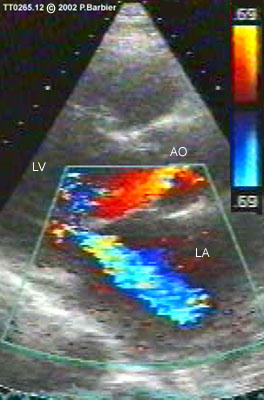
So, I'm sitting there, shirt off and we start the exam. I'm lying down on my back and Dr. Green takes a the "wand" and after applying some lubricating gel he applies the wand to my chest. A picture comes up in black and white on the screen and the Dr. begins pointing out parts of my heart. So now I'm thinking, "Cool. Give me the rubber stamp, Doc so I get back to work." But then he pauses in one area for a moment. Then, he flips a switch on the machine. The black and white switch to vivid colors. "The color is where your blood is moving. The brighter the color the more volume and thrust of the blood." So I'm seeing the colors and glancing at my watch. "So everything looks ok, Dr.?"

"Well, there are a couple of things that concern me."

Note to self. If I ever become a doctor, remove the word "concern" from my bedside vocabulary.

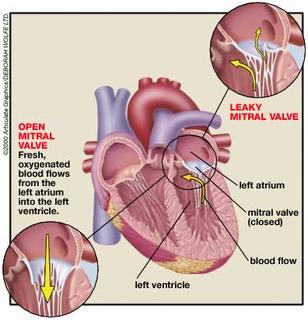
"Can you be more specific, Dr. Green" I ask. "Well, if you look at the bright colors, the whites, orange and reds, that's your blood." "And?" "Its going the wrong direction in your heart. The blood is traveling from your left atrium through your mitral valve and into your left ventricle. The problem is that that blood is regurgitating back into the left atrium. The result is that your heart is working not working efficiently. You have severe mitral valve regurgitation, Mr. Salvati. Your heart is growing and if we don't address this soon you'll be at in increased risk for heart attack, stroke or (my personal favorite) SUDDEN DEATH.

How do you digest this?

Denial: The Dr. doesn't know what he's talking about.

Fear: Never thought I would be checking mortality rates at 34.

Anger: Why me?

Acceptance: OK, let's find the best place and the best surgeon.

11 days to surgery

What is mitral valve regurgitation?


What is mitral valve regurgitation (MR)?
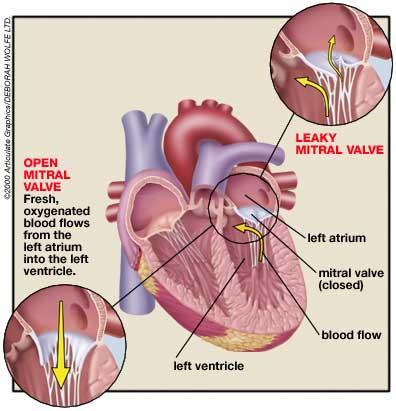
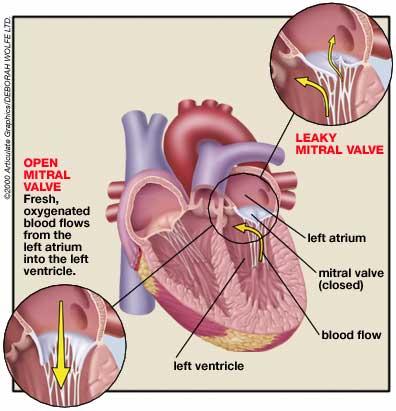
The mitral valve is similar to a one-way gate in the left side of your heart. Normally, the valve only allows blood to flow from the upper to lower heart chamber. But if the valve becomes diseased or injured so it cannot close properly, blood can leak backward (regurgitate) into the upper chamber (left atrium). This uncirculated blood causes the heart to work harder to pump the extra regurgitated blood (volume overload).
Mild cases of mitral valve regurgitation cause few problems, but more severe cases eventually weaken the heart and lead to heart failure.
See an illustration of the heart with its chambers and blood flow.

What causes mitral valve regurgitation?
There are two forms of mitral valve regurgitation: chronic and acute.
Chronic mitral valve regurgitation, the most common type, develops slowly over several years. The most common cause is mitral valve prolapse, in which the mitral valve flaps bulge the wrong way against the flow of blood, don't seal properly, and allow blood to leak backward. Other causes include heart failure, rheumatic fever, which can scar the heart valves, preventing them from closing completely; calcification of the tough ring of tissue (annulus) to which the mitral valve flaps are attached; congenital heart disease; and other heart problems.
Acute mitral valve regurgitation develops quickly and can be life-threatening. It occurs when the mitral valve or one of its supporting structures ruptures suddenly, creating an immediate overload of blood volume and blood pressure in the left side of the heart. Unlike chronic MR, your heart doesn't have time to compensate for the increased volume and pressure of blood. If not treated, acute MR can be fatal. Common causes of acute MR are heart attack and heart infection.

What are the symptoms?
If you have mild-to-moderate chronic mitral valve regurgitation, you may never develop symptoms. If you have moderate-to-severe disease, you may not have symptoms for decades. Depending on the severity of your mitral valve regurgitation and condition of your heart, you may not develop symptoms of heart failure until you're in your 40s, 50s, or 60s. Symptoms include shortness of breath with exertion, which later develops into shortness of breath at rest and at night; fatigue and weakness; and fluid buildup (edema) in the legs and feet.
With acute mitral valve regurgitation, you will be critically ill. Symptoms develop rapidly and include severe shortness of breath at rest, coughing, and rapid heartbeat.

How is mitral valve regurgitation diagnosed?
Most cases of mitral valve regurgitation are chronic and are diagnosed during a regular doctor's office visit. Acute mitral valve regurgitation is life-threatening and is usually diagnosed in the emergency room or while you are hospitalized.
Because you may not have symptoms with chronic mitral valve regurgitation, a specific type of heart murmur may be the first sign your doctor notices. Further tests will be needed to evaluate your heart and the severity of the regurgitation. Tests may include:
Various types of echocardiogram, a type of ultrasound to determine the severity of MR.
An electrocardiogram (EKG, ECG), to evaluate abnormal heart rhythms.
A chest X-ray, to evaluate heart size.
Cardiac catheterization, to determine the severity of MR and to look for coronary artery disease.
Tests for acute mitral valve regurgitation may include one or more of those used for chronic MR as well as a transesophageal echocardiogram, in which a device that sends sound waves is passed down the esophagus to take clearer images of the heart.

How is it treated?
Treatment for chronic mitral valve regurgitation includes monitoring your heart function and symptoms, preventing infection, and treating complications as they develop. Your doctor may prescribe medications, including: Vasodilators to help widen blood vessels and help the heart pump more efficiently.
Anticoagulants, such as warfarin (Coumadin), to prevent blood clots if you also have atrial fibrillation. Beta-blockers, or antiarrhythmics to control heart rate.
Antibiotics to prevent infections.

You may need surgery to repair or replace your mitral valve if the regurgitation becomes severe, if the size of your left ventricle (your heart's main pumping chamber) increases, or if your heart weakens. Mitral valve repair is preferred over replacement.
Treatment for acute mitral valve regurgitation occurs while you are hospitalized or in the emergency room. Because heart failure usually occurs with acute MR, vasodilators are given intravenously. Immediate surgery to repair or replace the valve will be necessary.