
Friday, October 14, 2005


Take my breath away.
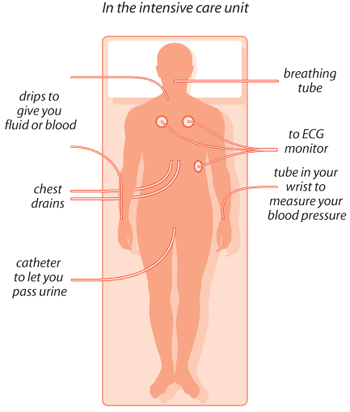
Wouldn’t you just know it? Just when our hero is sitting in the ICU and bellying-up to some cold mushroom, onion and sausage pizza…that’s when it happens. That’s always the point in our story when things go terribly awry. The cute girl gets killed, the CSI agent realizes he arrested the wrong person, the Cardiologist’s patient unexpectantly begins to crash. I was smug sitting upright in my ICU bed, G-52, basking in the fact that none of the nurses in their careers had ever seen a patient ordering take out. Sure, I had my humiliating hospital gown on but I was down to six electrodes, one IV line in my right arm and one drainage tube coming out of the bottom left rib cage.
There were three doctors there. Dr. Solow* from India, Dr. Evans* from Ireland and Dr. Rodriquez* from Chile. Each had their respective accents and set the stage nicely. They consulted, disagreed with one-another and debated with me, their patient, just looking for some reassurance and leadership. They finally agreed on all the variables and got started.
The procedure sucked. How’s that for eloquence? Even while taking one Xanax, IV Morphine, IV Demerol and two Percoset…I kid you not. I had all this and then I had three injections of Lanacaine at the site of the insertion applied at three different levels under my left pectoral between my ribs. The next 30 minutes were the most painful I had since they pulled out the chest tube a couple of days earlier. But when they were done I slowly started feeling better and marveled as I watched almost a liter of milky blood-like fluid removed from my chest. I’ll never look at penne with pink vodka sauce the same way again. The tube was draining into what looked like one of those old fashioned IV bottles that Dr. Frankenstein likely used. It was all glass, clear and shaped up to the top where the tube was inserted into a quarter size top with a soft membrane covering the top. The bottle had a vacuum affect drawing out the fluid first spraying and then eventually slowing to a drip and then stopping. When that was done, twenty minutes later, they removed the bottle and replaced it with the labyrinth of tubes, fat syringes and this grenade shaped plastic bulb that had all of the air squeezed out of it. The fluid now had a lot of places they could go and the doctors set-up various switching of the “train tracks” so that when more fluid built up, it would automatically come out into either the syringe or the grenade. I didn’t care, the pain was gone. They left in the catheter/garden hose that was meant to continue draining the fluid over night. This was it! They’ll pull the tube out tomorrow AM after a clean Echo and let me go on my merry way. This calls for pizza! My parents had come in from the waiting area and were relieved to see that I was in good spirits. They stuck around until the pizza got there and then went to get a bite for their selves around 8:15pm. They’d be back in an hour but had no idea what they would witness upon their return.
I ate three slices, which is more food than I’ve managed to eat all week. I had no appetite until now. I was watching baseball even though the Yanks made an early exit, and now, all the drugs were making little fire-flies dart around my field of vision. And so, the next 45 minutes were wonderful in the “I am truly over the worst of this now” find of way. Man, was I ever wrong.
[Deep breathing exercise to expand lungs. Thanks for your patience.]
It was quiet in this ICU tonight. When I first came down into recovery after the surgery it was chaotic. 11 patients, the max, with various connections to man-made contraptions meant to thwart Darwinism. Beeps, buzzers and tones constantly going off in a cacophony of chaos mixed with the wails of the infirmed and the disturbingly disinterested guffaws of the ICU staff made for the perfect healing environment. But tonight was different. There were only 6 patients which meant less beeps, wails and nurses guffawing. The nurses were actually empathetic, sweet and focused primarily on their patient. One nurse per patient. Tonight mine was Sarah, a 24 year old RN whose father had worked at the Cleveland Clinic as a nurse for 20 years, was looking after me. She was tall and thin and had a black bob with streaks of red in the front. She was shy but competent and you would think that this is the norm at all medical institutions, but what I came to realize during my week here in Cleveland is that there is incompetence at all levels, but I’ll save this for another entry. Let’s focus on the topic dujor. Scary shit.
When we last left our hero he was appearing in the DVD release of Fantasia, feeling happy and looking forward to going home soon. It was 9:00PM and he was lounging in his polka dot gown and plying the nurses with left over pizza. All was well. Through the main ICU doors came in Ben a tall kind RN who I had met and spoken with a few times both in the ICU as well as the heart center floor. I trusted and liked Ben. With him was Dr. Sidow*. Dr. Sidow was apparently the head of something. I never met her before, she didn’t introduce herself or directly address me. I might as well have been the coffee machine in the cafeteria. This happens a lot at “teaching” hospitals. In any given day I would be “observed” by 8 different cardiologists or surgeons who were at various levels in their career, some I would only see once and only once. And I have gathered one of the unwritten parts of this game is to agree with the “right” doctors and disagree with the “wrong” ones. Make your name but be careful how you do it. So Ben wanted to show Dr. Sidow how the procedure went. Ben folds back my blanket and she focuses on chest. She looks for barely a moment and declares to no-one in particular, “Why did they do it like this? They left it in the wrong position!” Now who am I to disagree with her? I’m not a medical professional and she IS a Dr. and to be fair since the three doctors left, no other fluid drained. So she turned a couple of the train switching valves and pulled on the syringe and in the process sucked extracted another 50CCs of fluid. She made a couple of more changes with more fluid slowly dripping into the grenade. And with this I started feeling some slight pressure in my sternum. “There we are, now that’s the way it should be, there needs to be constant suction.” And with that she and Ben walked away as quickly as they arrived. But the pressure was increasing unnervingly quickly. She and Ben were at the ICU exit about 20 yards away and I yelled, “Dr.! Ben!” But my breadth was be drained along with the fluid and I barely got out my cry for help. They turned and left at which point Sarah popped her head in. “How ya doing, sweetie?” “Um, I’m not sure. This doctor and Ben came over pulled some fluid out and now I feel like I have a tremendous amount of pressure on the center of my chest. “OK, I can give you more some more Demerol and then I will go find Ben.” Sarah quickly administered the additional drugs and they did nothing. Sarah was off to find Ben and the Dr. and this is precisely when my parents walked in.
I watched the blood drain from their faces as they walked up. There I was lying on the bed with a bunch of bloody tubes and contraptions coming out of my rib cage. I’m gasping for air and lying flat on my dripping with sweat. “What’s happening!” asked my mom.” (In between gasps) “T H E Y A R E L O O K I N G F O R T H E D O C T O R.” At this point Sarah gets back and says she found Ben but not the doctor. “Ben said it is normal to feel some pressure and than I can give you some Morphine.” And she does, dropping 25ccs of morphine into my IV on top of everything else floating around my system. (In between more exaggerated gasps “SARAH, I NEED A DOCTOR, IT’S GETTING WORSE!” “We need to get a doctor here right away!” My Mother says. “OK, I’m paging the staff cardiologist who is on duty” exclaims Sarah. At the Clinic they use a pain scale to determine how uncomfortable you are. You are asked constantly, “On a scale of 1-10, with 1 being the no pain and 10 being unbearable, how would you rate your pain?” In a mere 15 minutes I went from a 3 to a 9. When my parents left me an hour ago I was laughing and eating pizza. Now they are watching me splayed on my bed, writhing and unable to speak. My head is whipping from left to right and back again. Sweat is flying off my brow across the room and I feel as if I am being suspended in mid air with a Neanderthal spear driven right through the center of my chest and out my back. Imagine the movie Alien and just prior to the juvenile alien hatching from their human hosts. This is the only other way I can explain the pain. My parents are now looking left and right for help and Sarah reappears and announces that Dr. Moula is on her way down from Cardiology. And now some of the other nurses are gathering around but not doing anything in particular. I don’t think they knew what else to do. It was like slowing down to watch an in process car accident.
Dr. Moula burst on to the scene through the doors and she was pushing an Echocardiogram machine. Dr. Moula was a thick woman with some sort of Eastern European accent. After she quickly introduced herself she sat down on the bed next to me and focused on nothing but me and Sarah. “What do you feel?” She asked with focused determination. I managed to blurt out where the pain was. My father looked pale and had his forehead in his hand…which is the same thing I do when overly stressed. They were helpless, watching their second son and if they were like me at this point, they actually started to wonder whether or not I was going to make it. But at moments like this, you cannot allow those thoughts to embed themselves. You need to focus with the doctor. Dr. Moula worked the echo around me chest and told me everything she was going to do before she did it. She firmly requested tools from Sarah who remained remarkably calm. “There’s your mitral valve, it looks good. Your left and right atriums look ok. Stay focused, Mr. Salvati, I’m going to take care of you.” And, I believed her. “Ahh, I see! The catheter, it is rubbing against two sections of the heart. This syringe shouldn’t have been left on drain…otherwise this happens. Sarah, page the Cardiologist who performed this, I want to get permission to pull this out. It doesn’t need to be in there!” “P U L L I T O U T!!!” I yelled. “OK, I’m going to pull it out a little to see if that reduces the pain.” And she did, and it didn’t. “Sarah, get me a double saline syringe wash!” She attached the double syringe and told me she is adding fluid to relieve some of the irritation. At this point the pain shot up throughout my right shoulder and arm. “OH, MY SHOULDER!” “That’s it,” she said firmly, I am not waiting for permission! OK, Mr. Salvati, I am going to pull this out and you are going to feel better.” Dr. Moula then started pulling out the tube which seemed to go on forever. Earlier, the cardiologist who was performing the procedure told me that the heart is about 3.5 inches from where we are entering. I can handle that, I thought to myself. Well, Dr.Moula was still pulling like a clown pulling out tied scarves from magic hat. In total the catheter was more than 3 FEET inside my chest. Why? I don’t know.” “There, how do you feel?” “I don’t know.” I huffed. And then I heaved and tried to gasp and then it happened. The pressure and pain started to slowly ease. “I think it is getting better.” I said. “You’re going to be OK. They shouldn’t have left this in. There isn’t any more fluid to drain and when that happens the heart walls start rubbing against each other with the catheter in the middle. The heart gets irritated and it starts looking for more fluid to drain.” And now, just five minutes after the 3 feet of garden hose is removed from my chest, I’m feeling better again. “I’m a 3 now.” “OK, Mr. Salvati, if you need anything else just page me, OK?” “Will I have to do this again?” “No, you shouldn’t have to. Just get some rest and you’ll be fine in the morning.” And with that Dr. Moula left with little fanfare. I thanked her profusely as she left and after my parents were sure I was better, they too left for the hotel for a relieved but likely broken sleep.
I sat on the edge of my bed leaning over the tray table, still sweating but breathing better and feeling less pain. For a few minutes I sat and didn’t move, just happy to be there.
And now, it is the following evening and I am sitting in my parent’s hotel room. I made it out. I have another echocardiogram tomorrow afternoon, and if we get through that we are on our way. I have no electrodes, needles or tubes in me right now, and I want to keep it that way. The appointment is scheduled for 3:40 Friday afternoon. Please send good thoughts then if you remember cause it’s time to go home.
* These names have been changed.
~Joe
8 days post-op
There were three doctors there. Dr. Solow* from India, Dr. Evans* from Ireland and Dr. Rodriquez* from Chile. Each had their respective accents and set the stage nicely. They consulted, disagreed with one-another and debated with me, their patient, just looking for some reassurance and leadership. They finally agreed on all the variables and got started.
The procedure sucked. How’s that for eloquence? Even while taking one Xanax, IV Morphine, IV Demerol and two Percoset…I kid you not. I had all this and then I had three injections of Lanacaine at the site of the insertion applied at three different levels under my left pectoral between my ribs. The next 30 minutes were the most painful I had since they pulled out the chest tube a couple of days earlier. But when they were done I slowly started feeling better and marveled as I watched almost a liter of milky blood-like fluid removed from my chest. I’ll never look at penne with pink vodka sauce the same way again. The tube was draining into what looked like one of those old fashioned IV bottles that Dr. Frankenstein likely used. It was all glass, clear and shaped up to the top where the tube was inserted into a quarter size top with a soft membrane covering the top. The bottle had a vacuum affect drawing out the fluid first spraying and then eventually slowing to a drip and then stopping. When that was done, twenty minutes later, they removed the bottle and replaced it with the labyrinth of tubes, fat syringes and this grenade shaped plastic bulb that had all of the air squeezed out of it. The fluid now had a lot of places they could go and the doctors set-up various switching of the “train tracks” so that when more fluid built up, it would automatically come out into either the syringe or the grenade. I didn’t care, the pain was gone. They left in the catheter/garden hose that was meant to continue draining the fluid over night. This was it! They’ll pull the tube out tomorrow AM after a clean Echo and let me go on my merry way. This calls for pizza! My parents had come in from the waiting area and were relieved to see that I was in good spirits. They stuck around until the pizza got there and then went to get a bite for their selves around 8:15pm. They’d be back in an hour but had no idea what they would witness upon their return.
I ate three slices, which is more food than I’ve managed to eat all week. I had no appetite until now. I was watching baseball even though the Yanks made an early exit, and now, all the drugs were making little fire-flies dart around my field of vision. And so, the next 45 minutes were wonderful in the “I am truly over the worst of this now” find of way. Man, was I ever wrong.
[Deep breathing exercise to expand lungs. Thanks for your patience.]
It was quiet in this ICU tonight. When I first came down into recovery after the surgery it was chaotic. 11 patients, the max, with various connections to man-made contraptions meant to thwart Darwinism. Beeps, buzzers and tones constantly going off in a cacophony of chaos mixed with the wails of the infirmed and the disturbingly disinterested guffaws of the ICU staff made for the perfect healing environment. But tonight was different. There were only 6 patients which meant less beeps, wails and nurses guffawing. The nurses were actually empathetic, sweet and focused primarily on their patient. One nurse per patient. Tonight mine was Sarah, a 24 year old RN whose father had worked at the Cleveland Clinic as a nurse for 20 years, was looking after me. She was tall and thin and had a black bob with streaks of red in the front. She was shy but competent and you would think that this is the norm at all medical institutions, but what I came to realize during my week here in Cleveland is that there is incompetence at all levels, but I’ll save this for another entry. Let’s focus on the topic dujor. Scary shit.
When we last left our hero he was appearing in the DVD release of Fantasia, feeling happy and looking forward to going home soon. It was 9:00PM and he was lounging in his polka dot gown and plying the nurses with left over pizza. All was well. Through the main ICU doors came in Ben a tall kind RN who I had met and spoken with a few times both in the ICU as well as the heart center floor. I trusted and liked Ben. With him was Dr. Sidow*. Dr. Sidow was apparently the head of something. I never met her before, she didn’t introduce herself or directly address me. I might as well have been the coffee machine in the cafeteria. This happens a lot at “teaching” hospitals. In any given day I would be “observed” by 8 different cardiologists or surgeons who were at various levels in their career, some I would only see once and only once. And I have gathered one of the unwritten parts of this game is to agree with the “right” doctors and disagree with the “wrong” ones. Make your name but be careful how you do it. So Ben wanted to show Dr. Sidow how the procedure went. Ben folds back my blanket and she focuses on chest. She looks for barely a moment and declares to no-one in particular, “Why did they do it like this? They left it in the wrong position!” Now who am I to disagree with her? I’m not a medical professional and she IS a Dr. and to be fair since the three doctors left, no other fluid drained. So she turned a couple of the train switching valves and pulled on the syringe and in the process sucked extracted another 50CCs of fluid. She made a couple of more changes with more fluid slowly dripping into the grenade. And with this I started feeling some slight pressure in my sternum. “There we are, now that’s the way it should be, there needs to be constant suction.” And with that she and Ben walked away as quickly as they arrived. But the pressure was increasing unnervingly quickly. She and Ben were at the ICU exit about 20 yards away and I yelled, “Dr.! Ben!” But my breadth was be drained along with the fluid and I barely got out my cry for help. They turned and left at which point Sarah popped her head in. “How ya doing, sweetie?” “Um, I’m not sure. This doctor and Ben came over pulled some fluid out and now I feel like I have a tremendous amount of pressure on the center of my chest. “OK, I can give you more some more Demerol and then I will go find Ben.” Sarah quickly administered the additional drugs and they did nothing. Sarah was off to find Ben and the Dr. and this is precisely when my parents walked in.
I watched the blood drain from their faces as they walked up. There I was lying on the bed with a bunch of bloody tubes and contraptions coming out of my rib cage. I’m gasping for air and lying flat on my dripping with sweat. “What’s happening!” asked my mom.” (In between gasps) “T H E Y A R E L O O K I N G F O R T H E D O C T O R.” At this point Sarah gets back and says she found Ben but not the doctor. “Ben said it is normal to feel some pressure and than I can give you some Morphine.” And she does, dropping 25ccs of morphine into my IV on top of everything else floating around my system. (In between more exaggerated gasps “SARAH, I NEED A DOCTOR, IT’S GETTING WORSE!” “We need to get a doctor here right away!” My Mother says. “OK, I’m paging the staff cardiologist who is on duty” exclaims Sarah. At the Clinic they use a pain scale to determine how uncomfortable you are. You are asked constantly, “On a scale of 1-10, with 1 being the no pain and 10 being unbearable, how would you rate your pain?” In a mere 15 minutes I went from a 3 to a 9. When my parents left me an hour ago I was laughing and eating pizza. Now they are watching me splayed on my bed, writhing and unable to speak. My head is whipping from left to right and back again. Sweat is flying off my brow across the room and I feel as if I am being suspended in mid air with a Neanderthal spear driven right through the center of my chest and out my back. Imagine the movie Alien and just prior to the juvenile alien hatching from their human hosts. This is the only other way I can explain the pain. My parents are now looking left and right for help and Sarah reappears and announces that Dr. Moula is on her way down from Cardiology. And now some of the other nurses are gathering around but not doing anything in particular. I don’t think they knew what else to do. It was like slowing down to watch an in process car accident.
Dr. Moula burst on to the scene through the doors and she was pushing an Echocardiogram machine. Dr. Moula was a thick woman with some sort of Eastern European accent. After she quickly introduced herself she sat down on the bed next to me and focused on nothing but me and Sarah. “What do you feel?” She asked with focused determination. I managed to blurt out where the pain was. My father looked pale and had his forehead in his hand…which is the same thing I do when overly stressed. They were helpless, watching their second son and if they were like me at this point, they actually started to wonder whether or not I was going to make it. But at moments like this, you cannot allow those thoughts to embed themselves. You need to focus with the doctor. Dr. Moula worked the echo around me chest and told me everything she was going to do before she did it. She firmly requested tools from Sarah who remained remarkably calm. “There’s your mitral valve, it looks good. Your left and right atriums look ok. Stay focused, Mr. Salvati, I’m going to take care of you.” And, I believed her. “Ahh, I see! The catheter, it is rubbing against two sections of the heart. This syringe shouldn’t have been left on drain…otherwise this happens. Sarah, page the Cardiologist who performed this, I want to get permission to pull this out. It doesn’t need to be in there!” “P U L L I T O U T!!!” I yelled. “OK, I’m going to pull it out a little to see if that reduces the pain.” And she did, and it didn’t. “Sarah, get me a double saline syringe wash!” She attached the double syringe and told me she is adding fluid to relieve some of the irritation. At this point the pain shot up throughout my right shoulder and arm. “OH, MY SHOULDER!” “That’s it,” she said firmly, I am not waiting for permission! OK, Mr. Salvati, I am going to pull this out and you are going to feel better.” Dr. Moula then started pulling out the tube which seemed to go on forever. Earlier, the cardiologist who was performing the procedure told me that the heart is about 3.5 inches from where we are entering. I can handle that, I thought to myself. Well, Dr.Moula was still pulling like a clown pulling out tied scarves from magic hat. In total the catheter was more than 3 FEET inside my chest. Why? I don’t know.” “There, how do you feel?” “I don’t know.” I huffed. And then I heaved and tried to gasp and then it happened. The pressure and pain started to slowly ease. “I think it is getting better.” I said. “You’re going to be OK. They shouldn’t have left this in. There isn’t any more fluid to drain and when that happens the heart walls start rubbing against each other with the catheter in the middle. The heart gets irritated and it starts looking for more fluid to drain.” And now, just five minutes after the 3 feet of garden hose is removed from my chest, I’m feeling better again. “I’m a 3 now.” “OK, Mr. Salvati, if you need anything else just page me, OK?” “Will I have to do this again?” “No, you shouldn’t have to. Just get some rest and you’ll be fine in the morning.” And with that Dr. Moula left with little fanfare. I thanked her profusely as she left and after my parents were sure I was better, they too left for the hotel for a relieved but likely broken sleep.
I sat on the edge of my bed leaning over the tray table, still sweating but breathing better and feeling less pain. For a few minutes I sat and didn’t move, just happy to be there.
And now, it is the following evening and I am sitting in my parent’s hotel room. I made it out. I have another echocardiogram tomorrow afternoon, and if we get through that we are on our way. I have no electrodes, needles or tubes in me right now, and I want to keep it that way. The appointment is scheduled for 3:40 Friday afternoon. Please send good thoughts then if you remember cause it’s time to go home.
* These names have been changed.
~Joe
8 days post-op
Wednesday, October 12, 2005
Wednesday update 7:30pm
Hello once again.
I just talked to Joe's Mom and wanted to give everyone the update:
- The doctors drained the fluid this afternoon and there was enough of it to warrant continuing to do so overnight.
+ He had been having a difficult time breathing which has gotten better since the procedure so that's great news.
- He remains in the ICU and the doctors will reassess the situation tomorrow to give him a more solid understanding of how long he'll stay.
+ He's just ordered a large pizza and garlic cheese bread to his ICU bed so his appetite is finally coming back!
Although I can't call him, I did acquire the fax number for his ICU unit (216-445-5720) and am keeping him updated with all of your blog comments. Keep 'em coming!
Max and I are doing fine...trying to stay dry in this terrible weather we're having...and anxiously awaiting Daddy's return.
More to come tomorrow~
Allison
I just talked to Joe's Mom and wanted to give everyone the update:
- The doctors drained the fluid this afternoon and there was enough of it to warrant continuing to do so overnight.
+ He had been having a difficult time breathing which has gotten better since the procedure so that's great news.
- He remains in the ICU and the doctors will reassess the situation tomorrow to give him a more solid understanding of how long he'll stay.
+ He's just ordered a large pizza and garlic cheese bread to his ICU bed so his appetite is finally coming back!
Although I can't call him, I did acquire the fax number for his ICU unit (216-445-5720) and am keeping him updated with all of your blog comments. Keep 'em coming!
Max and I are doing fine...trying to stay dry in this terrible weather we're having...and anxiously awaiting Daddy's return.
More to come tomorrow~
Allison
Speed bump on the road to recovery
It’s Allison again…Joe tried to make an audio blog last night but for some reason it didn’t work. He wanted to personally fill you in on the latest details – which we hate to say -- are a bit of a speed bump on the road to recovery.
The last step in Joe’s preparation to leave the Clinic was a final echocardiogram (an ultrasound of his heart) to clear him to come home. They performed the “echo” yesterday afternoon and results showed swelling around the heart. They mentioned that this happens, although rarely, with their younger patients who tend to be in very good physical health. Go figure.
The cardiologist put him on steroids last night in an attempt to lessen the fluid accumulation without another, more invasive, procedure. We found out at 10:30am this morning that the steroids did not work and the fluid had actually increased overnight. Therefore, Joe will be readmitted to the ICU this afternoon so a team of cardiologists can insert a needle near his heart to drain this fluid.
The best case scenario: After 30 minutes, the fluid is completely drained and they can remove the tube. He would remain in ICU until tomorrow morning at which time he could go and spend a restful day and night in the hotel with his parents. Friday morning they would have him return for one final “echo” to confirm the fluid had not returned before being given his walking papers.
The worst case scenario: After 30 minutes, the fluid continues to drain and they are forced to leave the catheter in for at least 24 hours. Since this would take us to Thursday afternoon, they would keep him in ICU until Friday for observation at which time they would reassess the situation. They are (finally) setting his expectations that he could feasibly be in the hospital through the weekend in the event the fluid continues to develop.
So, the good news is that they detected the fluid now and not in another two weeks after he’s returned home. I’m sure the ramifications of this would be much worse and we are thankful he is still in the clinic to be taken care of.
The bad news is that the “echo” was administered yesterday just one hour after Max and I left Cleveland heading for home. We now must do what we can to support him from a thousand miles away which is really a bummer.
Joe remains strong, although disappointed, and continues to pull strength from all of the support from each of you. As you know, he will go back to not having a phone in ICU so the second best thing is for you to “comment” here on the blog and I will be sure he gets to read each and every one. I ask that you continue to send good, strong energy in Joe’s direction over the next few days and pray for a quick and painless procedure this afternoon.
Stay tuned…
Allison
5 days post-op
The last step in Joe’s preparation to leave the Clinic was a final echocardiogram (an ultrasound of his heart) to clear him to come home. They performed the “echo” yesterday afternoon and results showed swelling around the heart. They mentioned that this happens, although rarely, with their younger patients who tend to be in very good physical health. Go figure.
The cardiologist put him on steroids last night in an attempt to lessen the fluid accumulation without another, more invasive, procedure. We found out at 10:30am this morning that the steroids did not work and the fluid had actually increased overnight. Therefore, Joe will be readmitted to the ICU this afternoon so a team of cardiologists can insert a needle near his heart to drain this fluid.
The best case scenario: After 30 minutes, the fluid is completely drained and they can remove the tube. He would remain in ICU until tomorrow morning at which time he could go and spend a restful day and night in the hotel with his parents. Friday morning they would have him return for one final “echo” to confirm the fluid had not returned before being given his walking papers.
The worst case scenario: After 30 minutes, the fluid continues to drain and they are forced to leave the catheter in for at least 24 hours. Since this would take us to Thursday afternoon, they would keep him in ICU until Friday for observation at which time they would reassess the situation. They are (finally) setting his expectations that he could feasibly be in the hospital through the weekend in the event the fluid continues to develop.
So, the good news is that they detected the fluid now and not in another two weeks after he’s returned home. I’m sure the ramifications of this would be much worse and we are thankful he is still in the clinic to be taken care of.
The bad news is that the “echo” was administered yesterday just one hour after Max and I left Cleveland heading for home. We now must do what we can to support him from a thousand miles away which is really a bummer.
Joe remains strong, although disappointed, and continues to pull strength from all of the support from each of you. As you know, he will go back to not having a phone in ICU so the second best thing is for you to “comment” here on the blog and I will be sure he gets to read each and every one. I ask that you continue to send good, strong energy in Joe’s direction over the next few days and pray for a quick and painless procedure this afternoon.
Stay tuned…
Allison
5 days post-op
Tuesday, October 11, 2005
Sunday, October 09, 2005
Saturday, October 08, 2005
Please...just set our expectations!
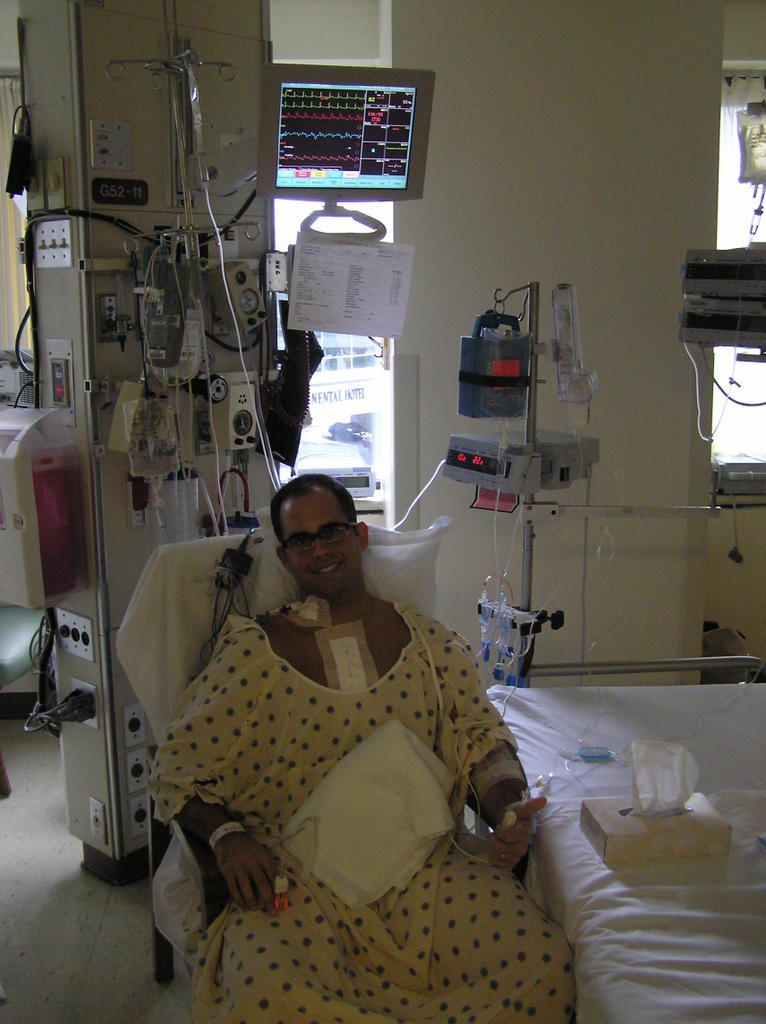
It's Sunday night at 10:13pm and I've just returned from visiting Joe for the 3rd and final time today. He was very much looking forward to entering today's blog and even has the mental frame of mind and voice to do so. Unfortunately, he still finds himself in the ICU which keeps him from having access to his laptop, cellphone and even his iPod. This is not because he isn't continuing to do great...quite the contrary, actually. It is merely because of a series of mistakes and misunderstandings that occurred after being led to believe he would be moved upstairs to the regular ward by early afternoon today.
I don't want to dwell or even give the impression that we aren't completely impressed with the clinic -- because we are. But we were told yesterday immediately following the surgery that he was doing so well he was considered a "fast tracker" -- someone who would be out of ICU sooner than the average patient. Of course, we all got excited and Joe was able to start looking forward to seeing Max.
At that point, Joe was assigned to a specific room "upstairs" that had a patient scheduled to be discharged today. Well, as it turns out, he wasn't released and instead of Joe being assigned to another room he is forced to wait until this gentleman is well enough to go home before he can leave ICU. This means that even though Joe is medically approved to get the catheter removed from his neck, the IV removed from his left arm and oh-so-ready to fall asleep in a place that does not echo with the sounds of heart monitoring machines beeping, the incessant alarms of blood pressure monitors sounding and his next door neighbor yelling at the top of her lungs during a sponge bath, that he must stay put until this guy is sent home.
Come 5:00pm, it was clear that Plan A was not underway and boy was Joe livid. It takes a lot to get him upset but this series of events meant that it would be another 18 hours before he could see his baby boy again -- and this was just not acceptable. And to think that, even though we would have all been disappointed, all of this could have been tolerable if they would have been able to set our expectations a bit better.
Needless to say, his Mom and I spoke privately with the head nurse who agreed to at least take out the IV and promised to reschedule the 3am X-ray for a more reasonable hour so he could get an uninterrupted night's sleep. At this point, we'll take what we can get. Luckily, Max was smart enough to make his Daddy a frame full of photos of his favorite pics of the two of them so Joe can gaze at these images as he presses the button on his hand-held morphine dispenser and slides into a drug-induced sleep.
But I digress.
The important thing here is that Joe is doing great. He sat in a chair today for a while (see the photo I sneakily took while the nurses weren't looking), was able to stomach some ice chips and cranberry juice and the biggest hurdle of all -- had a 3/4" thick tube removed from his chest that was 6" deep and causing him a great deal of discomfort. Around here, these are incredible milestones that we celebrated throughout the day.
So, we head into day #3 of our post-op journey and Joe promises to be back with you tomorrow to explain in his own words how his recovery is going. I fear my writing pales in comparison to his -- but I hope it gives you some insight to our day.
Thanks to all of you who have been trying to reach him at the hospital. He doesn't have a phone in ICU so try again Sunday and by then he will be upstairs and more than ready to take calls. But if he's asleep then you'll have to talk to me. Just setting your expectations.
~ Allison
Friday, October 07, 2005
It's OVER!
Hi everyone...it's Allison. We posted an audioblog with the update of today's successful surgery so click on the link below to hear all of the details!!!!!!!!!!!!!!
Thursday, October 06, 2005
Wouldn't it be ironic?
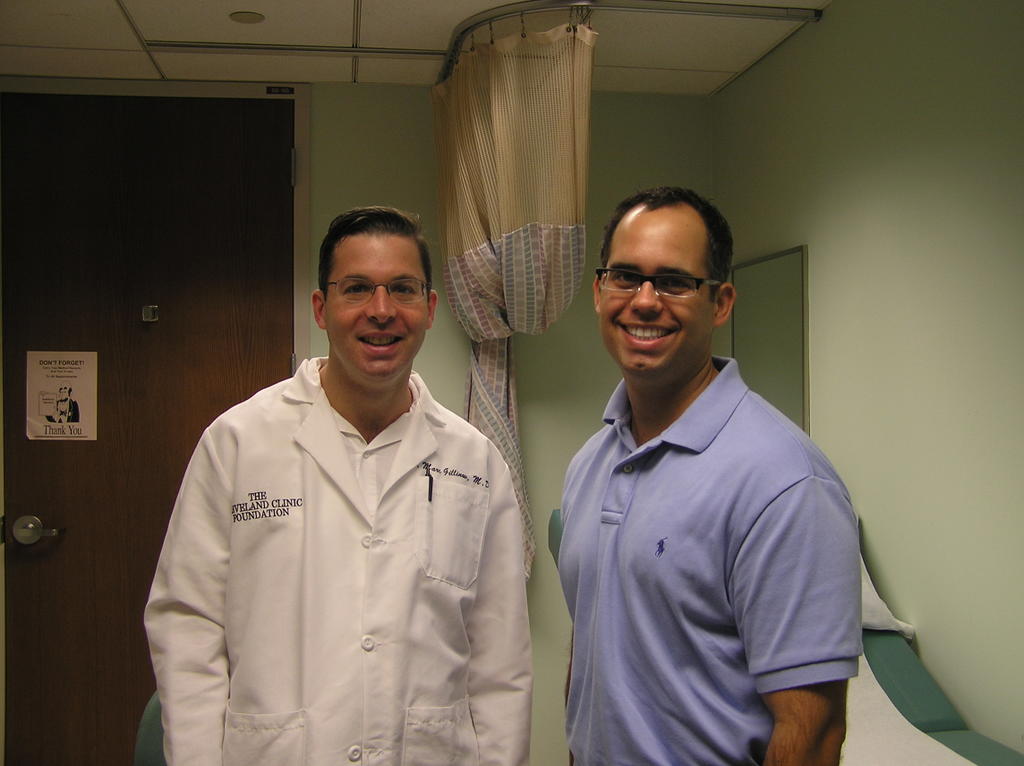 Wouldn’t it be ironic if the day I met the surgeon who was to operate on me that I broke his hand with an overzealous handshake? I’m no giant and don’t have a vice grip, but I would say I have a firm handshake. At 8:00 this morning I met Dr. Marc A. Gillinov (pictured above), my surgeon who will be leading tomorrow’s procedure. I stood up to shake his hand when he came into the room and I realized that I may have squeezed a little hard. Dr. Gillinov didn’t flinch or anything like that, but he gripped lightly…as he should. Right? I mean, his hands are his career and in this case, my well being. Perhaps he should be wearing Kevlar mittens when not operating. Shouldn’t that be a public service requirement considering his fantastic reputation? I’ll put my suggestion in the “How’s My Operating?” box outside the OR when they wheel me out. Dr. Gillinov allayed any remaining concerns I might have had coming into today.
This may sound completely irrelevant but regardless of my medical situation if I were to meet Dr. Gillinov (let’s call him Marc here) and The Hammer (Dr. Hammer, the Cardiologist/Bouncer) I think I’d like to have a beer with them. They’re nice, smart, funny guys. While being a nice person doesn’t make you a better surgeon, shouldn’t you have some sort of personal connection with the person who is going to operate on your heart? You are paying to have someone fix you but in the process it will cause you and your family physical and mental pain. I have a tattoo on my ankle. I got it six years ago while in San Francisco at the same tattoo parlor that Janis Joplin went to, but that too is irrelevant. The relevant point is that I paid someone (Rick) to leave an indelible mark on me and in the process inflict a great deal of pain over the course of an hour and a half…It was important that I got to know Rick at least a little so I went back a couple of times and chatted with him a fair amount more than most of his other clients. This too will leave an indelible mark both mentally and physically on me and so Marc, you and Rick are now in the same place in my brain. You’re both artists. Both have well trained eyes and hands and both are leaving me different than when I first met you. There are really only two differences; 1. Marc doesn’t have spider-web tattoos behind each of his ears. 2. Rick is slightly less educated.
So tomorrow AM is the big show, Everyone. Here is the rough schedule. A detailed MS Project will follow shortly.
4:15AM: Wake-up – wash with antibacterial soap provided, gargle with Listerine, dress
5:15AM: Check in
6:15AM: Pre-op preparation (2 hours of chest shaving)
7:15AM: Anesthesiologist gives me “something to take the edge off”
7:45AM: IV’s and ECG sensors placed on my body
8:00AM: General anesthesia administered through my IV
8:01AM: Vision will blur
8:02AM: Hearing will fade
8:05AM: Breathing tube inserted into my throat
8:15AM: Scalpel to skin
9:15AM: Heart stopped and bypass machine initiated
9:30AM: Mitral Valve accessed and repaired
11:30AM: Sew-up
12:00PM: Hearing will return slowly
12:15PM: Vision will return slowly
2:00PM: Breathing tube removed
2:15PM: Family reunion
3:30PM: Blog update
8:05PM: Tune to ESPN to watch Yankees slap around Anaheim
So that’s it! One more thank you to every one of the many friends and family who have reached out with tremendous support, prayers, calls and notes. I am truly blessed.
~Joe
0 days left
By your side, always.
I want to share with Joe, and everyone reading his blog, how completely in love I am with this man. I could not be more proud of how strong and optimistic he has been through these past few months in anticipation of his surgery. Finding out he needed the operation, while I was in the 7th month of my pregnancy, was tough timing to say the least. He was able to focus on doing his research, picking the surgery date and then essentially putting the procedure aside as he concentrated on taking care of me and the preparing for the impending birth of our beautiful son.
All of you who know Joe realize how lucky you are to have him in your life. He is the smartest, funniest and most loyal friend anyone could have. I, however, have the special treat of being his wife and truly consider myself the luckiest girl in the world. There are a million things awaiting he and I…the least of which is watching Max grow into a little person…and I cannot wait to reach each new chapter with him by my side.
Thanks to all of you for your amazing support. It’s been such a rush to come back to our hotel each evening to read your comments and emails full of heartfelt encouragement and humorous cheer. Joe has been hearing from people he hasn’t been in touch with for over a decade -- proving the special network of people we are a part of as well as the power of the Web.
Joe, I will be the last person you see before your surgery and the first person by your side when you wake up. Tomorrow at this time we will have jumped the hurdle that has been facing us and we will have the immense pleasure of looking back and knowing we beat it – together. I love you more than you will ever know.
~ Al
All of you who know Joe realize how lucky you are to have him in your life. He is the smartest, funniest and most loyal friend anyone could have. I, however, have the special treat of being his wife and truly consider myself the luckiest girl in the world. There are a million things awaiting he and I…the least of which is watching Max grow into a little person…and I cannot wait to reach each new chapter with him by my side.
Thanks to all of you for your amazing support. It’s been such a rush to come back to our hotel each evening to read your comments and emails full of heartfelt encouragement and humorous cheer. Joe has been hearing from people he hasn’t been in touch with for over a decade -- proving the special network of people we are a part of as well as the power of the Web.
Joe, I will be the last person you see before your surgery and the first person by your side when you wake up. Tomorrow at this time we will have jumped the hurdle that has been facing us and we will have the immense pleasure of looking back and knowing we beat it – together. I love you more than you will ever know.
~ Al
Wednesday, October 05, 2005
It is all in a smile
The wizards had good things to say.
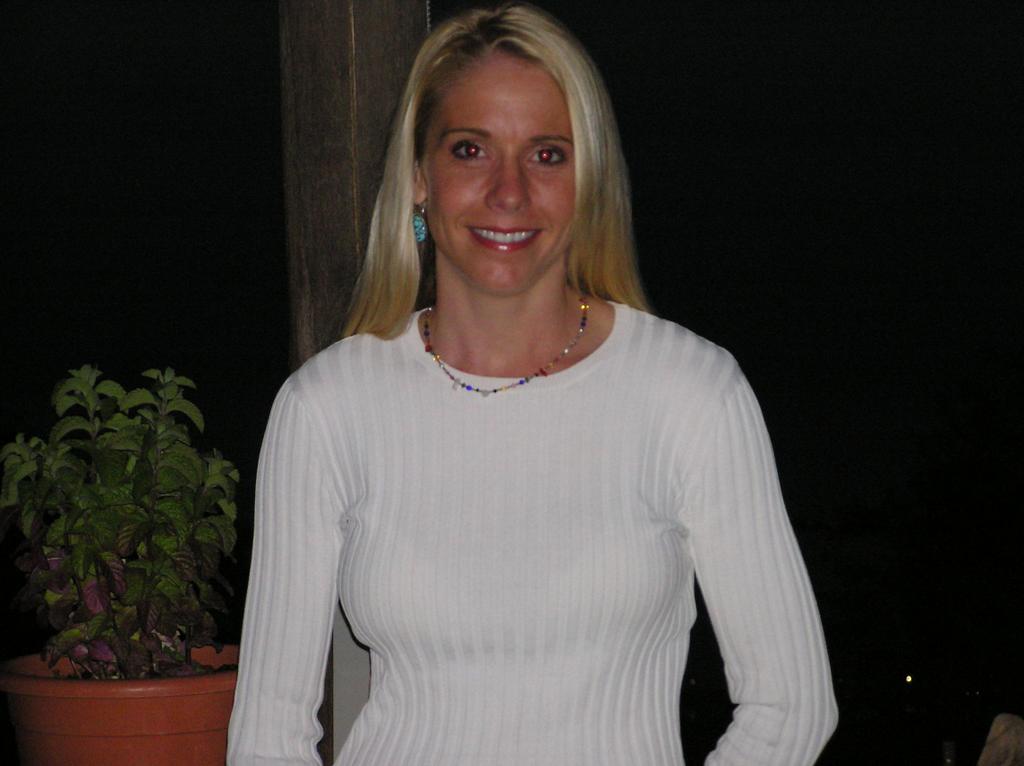
Today I met no less than 17 different specialists and technicians employed by the Cleveland Clinic. My second to last appointment was with Dr. Hammer, my cardiologist. Dr. Hammer, who was a bartender and bouncer at a bar downtown during his college days gave me the green light to have the procedure through a minimally invasive technique which is a little more complicated and lengthy but has the benefit of a lot less trauma. Rib-splitters need not apply. (Hammer, the bouncer…are you serious?)
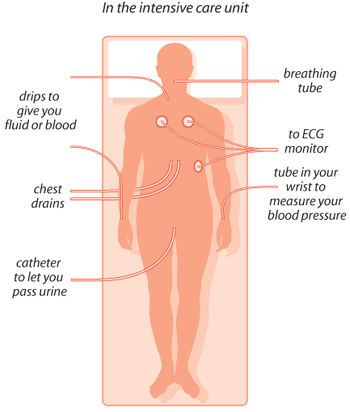
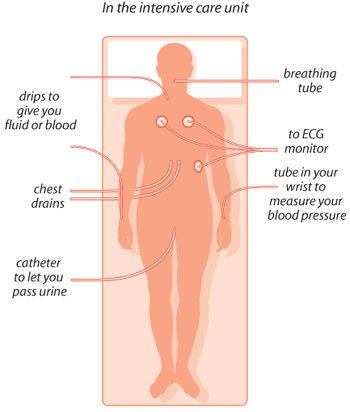
Take your thumb and place it at the base of your throat where your collarbones come together. Go on, this is an “interactive” exercise. The incisions will begin where your thumb is resting and move down the center of your chest approximately 4 inches which is about 4 ribs down from the top. At this spot, the incision will go another inch to the left portion of your chest in the form of a “J”. One inch of this rib will be broken/cut and removed. This is the space that Dr. Gillinov, your surgeon will be using to access your heart. The other members of the surgical team (about12 professionals) will then have a drink, smoke a Pall Mall and laugh at that birthmark you have that is eerily similar to Dick Cheney’s profile. Then, the team will stop your heart and circulate your blood through a machine that will keep it oxygenated. Did I mention the anesthesia? Yeah, you’ll have some of that. Dr. Gillinov will then do his magic, slicing into your heart’s outer wall until he reaches the Mitral Valve which connects your left atrium to your left ventricle. His repair technique will depend upon what he discovers when he is in there….but you won’t know a thing until you wake up groggily trying to remember where/who you are and why you have 7 tubes sticking out of various parts of your body. You’re in the ICU which is the last place someone who needs rest should be. But it is over, and just beginning at the same time.
The good news? You made it.
The really good news? Max started smiling today.
~Joe
1 days left
Tuesday, October 04, 2005
Ben
Hello, Everyone.
We arrived in Cleveland this afternoon around 3:30. I knew Max would be a jet-setter, but I didn’t expect his first trip to be at 6 weeks, let alone to Cleveland. Our driver took us from the airport on the west side of Cleveland to the Clinic which is on the east side of the city. Ben, our driver who was about 65 years old and wore very comfortable shoes paired with a very uncomfortable suit said he moved here from Massachusetts 35 years ago. He pointed out the “sites” along the way. He showed us the theater where Tom Hanks got his start and then pointed out Jacobs’s field. With this I gave him my condolences on the Indians collapse. He was appreciative and then he said he was now rooting for the Red Sox. It was at this point that I realized that I need to conceal my fervor for the Yankees until AFTER my surgery. You never know who is rooting for whom.
Ben asked who wasn’t well. Allison and I looked at each other a little confused and then we realized that our hotel was on the Cleveland Clinic campus. Allison shared with Ben the upcoming events we had planned. Ben was quiet, pensive and then said, “I’ll be thinking about you on Friday morning.” We smiled and said, “thank you.” 5 minutes later we arrived at the hotel…5 very quiet minutes. After the bellhop took the bags and Allison and Max were making their way through the revolving door, Ben stepped up to me, shook my hand firmly and looked at me deeply with his steely grey eyes. “I’ll be praying for you, Joe.” “Thank you, Ben.” And then Ben closed his trunk and said, “I knew I was waiting for someone today, I just didn’t know who until now.” I looked back at him momentarily and said “I’m glad it was us, Ben.”
Tomorrow is the day of tests…a lot of tests. Here is my schedule for Wednesday:
8:30 AM Sign in at Desk F12, Floor 1
9:00 AM CatScan
10:00 AM Echocardiogram
11:00 AM Chest X-Ray
11:10 AM Blood work
12:45 PM Meeting with Dr. Hammer, Cardiologist to review tests and get clearance for surgery.
2:30 PM 1.5 hour expectation meeting with Cardiovascular nurses – Review from start to finish of what to expect from the first the moment I come in the day of the surgery until I come home.
I thought some of you might like to know a little more about the operation. And as many of us know, there is only so much you can learn from reading. So, how about a demonstration? How about a video of the surgery? The following link is an edited excerpt of the surgery I’ll be undergoing on Friday. The video is only 6 minutes but the operation can last up to 4 hours. It is edited down to include only the actual repair. WARNING: While not overtly disturbing, the video IS graphic. As an added bonus, the video you will watch is of a surgery Dr. Marc A. Gillinov performed. He is my surgeon. Put aside that rare prime rib for a moment and take a look.
http://www.clevelandclinic.org/heartcenter/pub/guide/disease/valve/mvrepair.htm
~Joe
3 days left
We arrived in Cleveland this afternoon around 3:30. I knew Max would be a jet-setter, but I didn’t expect his first trip to be at 6 weeks, let alone to Cleveland. Our driver took us from the airport on the west side of Cleveland to the Clinic which is on the east side of the city. Ben, our driver who was about 65 years old and wore very comfortable shoes paired with a very uncomfortable suit said he moved here from Massachusetts 35 years ago. He pointed out the “sites” along the way. He showed us the theater where Tom Hanks got his start and then pointed out Jacobs’s field. With this I gave him my condolences on the Indians collapse. He was appreciative and then he said he was now rooting for the Red Sox. It was at this point that I realized that I need to conceal my fervor for the Yankees until AFTER my surgery. You never know who is rooting for whom.
Ben asked who wasn’t well. Allison and I looked at each other a little confused and then we realized that our hotel was on the Cleveland Clinic campus. Allison shared with Ben the upcoming events we had planned. Ben was quiet, pensive and then said, “I’ll be thinking about you on Friday morning.” We smiled and said, “thank you.” 5 minutes later we arrived at the hotel…5 very quiet minutes. After the bellhop took the bags and Allison and Max were making their way through the revolving door, Ben stepped up to me, shook my hand firmly and looked at me deeply with his steely grey eyes. “I’ll be praying for you, Joe.” “Thank you, Ben.” And then Ben closed his trunk and said, “I knew I was waiting for someone today, I just didn’t know who until now.” I looked back at him momentarily and said “I’m glad it was us, Ben.”
Tomorrow is the day of tests…a lot of tests. Here is my schedule for Wednesday:
8:30 AM Sign in at Desk F12, Floor 1
9:00 AM CatScan
10:00 AM Echocardiogram
11:00 AM Chest X-Ray
11:10 AM Blood work
12:45 PM Meeting with Dr. Hammer, Cardiologist to review tests and get clearance for surgery.
2:30 PM 1.5 hour expectation meeting with Cardiovascular nurses – Review from start to finish of what to expect from the first the moment I come in the day of the surgery until I come home.
I thought some of you might like to know a little more about the operation. And as many of us know, there is only so much you can learn from reading. So, how about a demonstration? How about a video of the surgery? The following link is an edited excerpt of the surgery I’ll be undergoing on Friday. The video is only 6 minutes but the operation can last up to 4 hours. It is edited down to include only the actual repair. WARNING: While not overtly disturbing, the video IS graphic. As an added bonus, the video you will watch is of a surgery Dr. Marc A. Gillinov performed. He is my surgeon. Put aside that rare prime rib for a moment and take a look.
http://www.clevelandclinic.org/heartcenter/pub/guide/disease/valve/mvrepair.htm
~Joe
3 days left
Allison
So we’re off tomorrow; up, up and away to a city I never thought I would visit. It isn’t as if there is something wrong with Cleveland. Quite the contrary. Cleveland is one of those innocuous, nondescript cities. It isn’t Miami, LA or NY with the flash or fashion. It isn’t San Francisco, Chicago or New Orleans with their foodies or rich cultural tapestries. Now don’t get me wrong. Cleveland does have the Rock and Roll Hall of Fame. And they have the Browns, whom until recently I believed were named after the color. “Oh no, here comes the color brown. I’m so scared!” Actually they were named after their first coach, Paul Brown. Regardless, still a tough franchise to merchandise. But Cleveland may become one of my favorite cities once the good doctors do a little nip and tuck. Once there, I’ll give you my limited first hand thoughts. You’ll have to wait a day because Wednesday I have 8 hours of tests. Jeez…8 hours.
But this post is really meant to say thank you to the person from whom I’ve gathered the most strength during the last few months; my wonderful wife, Allison. Allison, thank you for your courage, resolve and support. This surgery is a minor speed bump for you and me. When we get back and I’m feeling up to it we will return to our normal life. The fine dining at Denny’s, the NASCAR races, the Swingers’ nights, building our lawn ornament collection and plenty of our favorite boxed white zinfandel.
~Joe
4 days left
Sunday, October 02, 2005
This is when...
It is when the sun sits low in the sky like a child’s giant orange sucker.
It is when the crickets have retreated to the after-grass while the shadows curl lazily around the maples.
It is when the air is crisp and has the faint smell of cedar embers from an early season fire.
It is when leaves rustle with the faintest of breezes, their edges just beginning to turn.
This is when the Red Sox suck most.
~Joe
5 days left
It is when the crickets have retreated to the after-grass while the shadows curl lazily around the maples.
It is when the air is crisp and has the faint smell of cedar embers from an early season fire.
It is when leaves rustle with the faintest of breezes, their edges just beginning to turn.
This is when the Red Sox suck most.
~Joe
5 days left
Saturday, October 01, 2005
Dear Max
Dear Max,
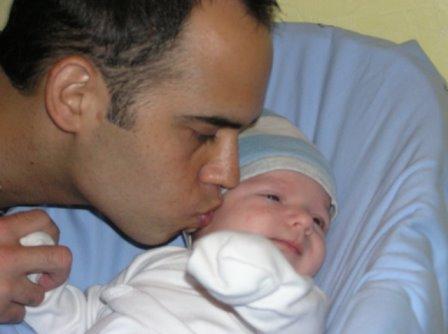
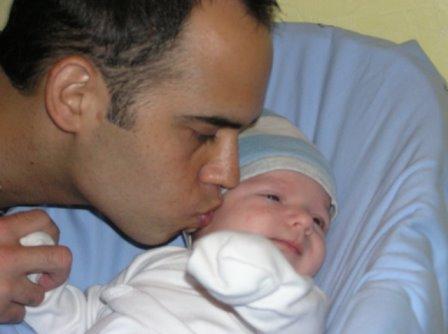
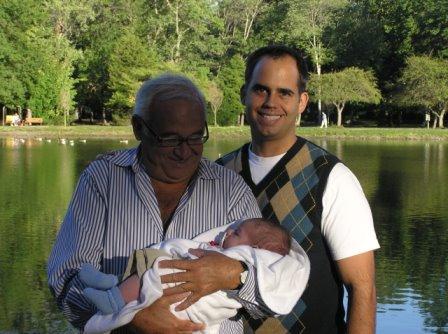
I was saving this for when you got older, but then I realized I had nothing to lose by sharing with you what I have so far. Mom doesn’t even know this but about a week before you were born I started writing a list of observations, beliefs and in some cases personal experiences that in time, you will either call upon as counsel, disagree with or experience for your self. The sources vary as much as the topics. Some of the below I’ve read, some have be shared with me by your Nono pictured with you and me above and some conclusions I’ve reached on my own. I’ll keep adding to the list, but this is what I have so far…
1. Family comes first.
2. Even though family comes first, they can be a pain in the butt.
3. You can pick your friends but you can’t pick your family…pick wisely.
4. Food is one of the pure, unadulterated joys in life.
5. Women love a man who can cook.
6. Always respect and love your mother. You’ll never understand how much she and I love you until you have your own children.
7. The Yankees, the Giants and the Knicks.
8. You’ll learn more about a person by listening to them for 1 minute then you will by talking to them for 10 minutes.
9. People love to hear themselves talk.
10. Learn as much about your heritage as you can; it is a tremendous part of what makes you you.
11. Buy a house/apartment/condo as soon as you are able.
12. It is OK to be scared.
13. It is OK to admit you are scared.
14. It is NOT OK to avoid your fears…they will only get worse if you do.
15. Whether you think you can or you can’t…you are right.
16. Sooner or later the other guy will blink.
17. Confidence can compensate for talent.
18. Arrogance can undermine talent.
19. Save early and often.
20. Don’t mortgage the future for a lifestyle today.
21. Things don’t bring you happiness.
22. You can’t be happy with someone else until you are happy with yourself.
23. Don’t take your health for granted.
24. Get a check-up every year.
25. With all people, no matter what the interaction, always exceed expectations.
26. You have to believe in yourself before others will believe in you.
27. Respect is earned.
28. First impressions are almost always right.
29. People judge you by what you wear and how you speak.
30. It is always better to be overdressed rather than underdressed.
31. Get in first, leave last.
32. Exercise is an excellent confidence booster.
33. Things are never as good or as bad as you think they are.
34. No matter what you do, do it with the highest degree of integrity.
35. The past is done and the future will come but today is malleable.
36. If you’re going to pull weeds, make sure you get the roots.
37. Don’t EVER put sugar in your tomato sauce.
38. Hold the door open for women.
39. Anyone older than you should always be addressed as Mr. or Mrs. unless they tell you otherwise.
40. Watch the ball not his feet.
41. If you haven’t failed at something you aren’t trying hard enough.
42. To make octopus tender you need to cook it with a wine cork.
43. Never burn bridges.
44. Learn to trust your instincts.
45. Never pay for the extended warranty.
46. The best time to buy a new car is in September.
47. Never buy a new car.
48. Yes, you can shave against your beard.
49. If someone overly flatters you without them really knowing you, don’t trust them.
50. Learn a second language, only Americans are too self absorbed to only know English.
51. Travel as much as you are able to.
52. Respect the customs of the country you are in.
53. If you don’t ask her, you’ll never know.
54. No, I didn’t have the internet growing up.
55. Yes, I know that makes me old.
56. Flirting can get you more than dates.
57. Don’t go to a gun fight with a knife.
58. Do what you love; the rest will take care of itself.
59. It is as important to know your weaknesses as your strengths.
60. Live for today but plan for tomorrow.
61. You will learn to love foie gras.
62. Be wiser than other people, but never let them know.
63. One of the symptoms of an approaching nervous breakdown is the belief that one's work is terribly important.
Love,
Dad
6 days left
Friday, September 30, 2005
Thinking yourself to greater health
The more we learn about how the mind and body work the more we realize that there is a direct correlation between each of their states. The article below in this week's Newsweek discuss the connection between helathy hearts and positive mental attitudes and outlooks.
Mediation, Cognitive Therapy, Biofeedback are just some of the means of mending your heart with your mind. If that doesn't work, watch a couple of episodes of COPS and no matter what is going on in your life you'll know it could be worse.
************************
The Good Heart
Diet and exercise are not the whole secret to cardiovascular health. Mounting evidence suggests that your psychological outlook is just as important.
By Anne Underwood
Newsweek
Oct. 3, 2005 issue - You can call it the Northridge Effect, after the powerful earthquake that struck near Los Angeles at 4:30 on a January morning in 1994. Within an hour, and for the rest of the day, medics responding to people crushed or trapped inside buildings faced a second wave of deaths from heart attacks among people who had survived the tremor unscathed. In the months that followed, researchers at two universities examined coroners' records from Los Angeles County and found an astonishing jump in cardiovascular deaths, from 15.6 on an average day to 51 on the day of the quake itself. Most of these people turned out to have a history of coronary disease, or risk factors such as high blood pressure. But those who died were not involved in rescue efforts or trying to dig themselves out of the rubble. Why did they die? In the understated language of The New England Journal of Medicine, "emotional stress may precipitate cardiac events in people who are predisposed to such events." To put it simply, they were scared to death.
Folk medicine has always recognized that a sudden fright or bad news can be fatal. And the same Greek word, meaning "constriction," is the root of both "anger" and "angina." But the Northridge study—and others involving survivors of the 1981 Athens earthquake and the 1991 Iraqi Scud-missile attacks on Israel—helped fuel new research in what might be called psychocardiology, the profound connections between emotions and the cardiovascular system. For a long time, cardiologists resisted the idea that the heart, the sturdy wellspring of life, can be fatally deranged by a mental event. But it's not just sudden shocks like earthquakes that kill. Mounting evidence suggests that chronic emotional states such as stress, anxiety, hostility and depression take a far greater toll. "Fifty percent of people who have heart attacks do not have high cholesterol," points out Edward Suarez, associate professor of psychiatry and human behavior at Duke. The risk of psychological and social factors are almost as great as obesity, smoking and hypertension, the traditional medical markers for cardiovascular disease—which afflicts 70 million Americans and is the nation's No. 1 killer. Researchers are now starting to learn why. And a growing number of clinics are putting that insight to work in programs that tackle heart disease at one of its most unlikely sources: in the mind.
Our understanding has proceeded from the anecdotal to the epidemiological to the search for underlying mechanisms. As a critical-care nurse at Mad River Community Hospital in northern California in the 1980s, Debra Moser saw repeatedly how patients' attitudes seemed to affect the course of their heart disease. She was struck by one case involving a man in his 50s with an uncomplicated heart attack. He should have been out of the hospital within two or three days, but he lingered for six. "It was the first time I appreciated the power of negative thinking," says Moser. "He was very depressed, which is not unusual after a heart attack. But he obsessed over everything. He was hypervigilant about his case. It seemed to us that he worried himself into episodes of recurrent ischemia and chest pain." The chest pain wasn't just in his mind; tests showed reduced blood flow to the heart. Within a year, he suffered another heart attack and died.
Years later, Moser, now a professor of nursing at the University of Kentucky in Lexington, sought to quantify the effects she observed in that patient. At a meeting of the American Heart Association last fall she presented the results of a trial involving 536 heart-attack patients. She had measured their anxiety levels with a standard multiple-choice psychological test, and kept track of whether they had further complications—such as a second heart attack—while in the hospital. Those who scored the highest for anxiety on the psychological tests were four times more likely to suffer complications than those with the lowest scores. The lesson was clear: "Every day we take patients' blood pressure and listen to their heart," she says, "but we rarely do a systematic assessment of their psychological state, even though anxiety and depression are major risk factors."
In fact, doctors are finding that psychosocial factors pose far greater risks than they previously realized. Take depression. It at least doubles an otherwise healthy person's heart-attack risk, says Dr. Michael Frenneaux, professor of cardiovascular medicine at the University of Birmingham in England. And for people who have suffered a heart attack in the past, depression quadruples or even quintuples the risk of a second one. Hostility is an increasingly important risk factor, too. High hostility levels, as measured by a standard test, increased the chances of dying from heart disease by 29 percent in a large study of patients at Duke—and by more than 50 percent in people 60 and younger.
Even childhood trauma seems to have an impact on heart disease later in life. In a recent survey of more than 17,000 adults in San Diego, Dr. Maxia Dong at the Centers for Disease Control and Prevention found that heart-attack risk went up by 30 to 70 percent in people who reported adverse childhood experiences, such as physical, sexual or emotional abuse, domestic violence or having family members who abused drugs or alcohol. The one reassuring note: parental separation or divorce, alone among the 10 variables studied, had no statistical effect on the risk of future heart attacks.
And if stress in childhood can lead to heart disease, what about current stress-ors—longer work hours, threats of layoffs, collapsing pension funds? A study last year in The Lancet examined more than 11,000 heart-attack sufferers from 52 countries and found that in the year before their heart attacks, patients had been under significantly more strains—from work, family, financial troubles, depression and other causes—than some 13,000 healthy control subjects. "Each of these factors individually was associated with increased risk," says Dr. Salim Yusuf, professor of medicine at Canada's McMaster University and senior investigator on the study. "Together, they accounted for 30 percent of overall heart-attack risk." But people respond differently to high-pressure work situations. The key to whether it produces a coronary seems to be whether you have a sense of control over life, or live at the mercy of circumstances and superiors.
That was the experience of John O'Connell, a Rockford, Ill., laboratory manager who suffered his first heart attack in 1996, at the age of 56. In the two years before, his mother and two of his children had suffered serious illnesses, and his job had been changed in a reorganization. "My life seemed completely out of control," he says. "I had no idea where I would end up." He ended up on a gurney with a clot blocking his left anterior descending artery—the classic "widowmaker." Two months later he had triple bypass surgery. A second heart attack when he was 58 left his cardiologist shaking his head. There's nothing more we can do for you, doctors told him.
Why do these stressors have such a potent effect? On the most obvious level, emotional states affect behavior. Depressed, angry people are less likely to stick with diet and exercise regimens and are more likely to smoke. In one study, the most hostile subjects consumed 600 more daily calories than the least hostile.
But behavior is only the beginning. Negative emotions can have direct effects, too, by provoking the stress response of the classic fight-or-flight mechanism. The body releases stress hormones, such as cortisol and epinephrine (adrenaline). In response, blood pressure and blood-glucose levels increase, while chemical changes in the blood enhance the clotting reaction to help heal wounds. In the short term, these are survival mechanisms. But over the long haul, chronic high blood pressure and elevated glucose damage blood vessels.
Current research focuses on the effects of inflammation. "Hostile and depressed people respond to the world in a chemically different way," says Suarez. They interpret more situations as stressful, provoking the release of more stress hormones. The immune system responds by ratcheting up inflammation, which promotes heart disease at every stage—from plaque formation to heart attack. In a 2004 study, Suarez found that people who score high on tests for anger, hostility or depression have higher blood levels of an inflammatory marker called C-reactive protein, which is strongly correlated with cardiovascular risk. "In those who were positive for all three traits, CRP levels were twice as high," he says. Similarly, Amy Ferketich at Ohio State University tested the blood of depressed versus nondepressed heart-failure patients—and found the depressed had nearly twice the levels of an inflammatory compound called TNF-alpha.
Inflammation aside, it's now clear that adrenaline itself can wreak havoc on the heart. Dr. Ilan Wittstein of Johns Hopkins recently identified a condition called stress cardiomyopathy, or "broken-heart syndrome," which looks on the surface a lot like a heart attack. Wittstein's patients had all experienced major shocks—the sudden death of a parent or child, a car accident, an armed robbery, even a surprise birthday party—and their hearts' ability to pump had suddenly weakened. Their symptoms mimicked those of a heart attack. Even their EKGs read like those of heart-attack patients. Yet these people showed no sign of blockage in their coronary arteries and very little of the blood-chemistry markers of heart-tissue death. And unlike heart-attack survivors, who take months to recover, these folks were usually fine within 72 hours. What was going on in their chests? Although there's still debate about the exact mechanism, Wittstein notes that the patients' blood levels of adrenaline were 30 times higher than normal, four to five times higher even than in patients undergoing an actual heart attack. He suspects this huge dose of a powerful hormone disrupts the way heart cells take up calcium, which is essential for heart-muscle cells to contract.
If negative or stressful emotions contribute to heart disease, could their opposites represent an avenue for treatment or prevention? Consider what happened when University of Utah psychologist Timothy Smith assigned 82 college students a task designed to cause stress. They had to argue either for or against a controversial topic, like raising the Social Security retirement age. Their responses, they were told, would be graded for clarity, organization and persuasiveness—and would be recorded on videotape. But first, they were asked to write a few paragraphs about either a close, supportive friend or a casual acquaintance. During the subsequent filming, says Smith, "Heart rate and blood pressure went up a lot. But they went up less when people spent a minute or two beforehand thinking of someone who mattered to them." Over a period of years, the effects of having such supportive friends—and appreciating them—would be cumulative.
Optimism seems to have similar benefits, and may even help slow the progression of atherosclerosis. Psychologist Karen Matthews at the University of Pittsburgh observed 209 healthy, postmenopausal women for three years and found that the most optimistic ones had very little thickening in their carotid arteries—just 1 percent, versus as much as 6.5 percent in the pessimists.
Even laughter is starting to look like a cardiac elixir. In one recent study, Dr. Michael Miller of the University of Maryland School of Medicine found that watching a funny movie for 15 minutes relaxed people's peripheral arteries and increased blood flow for as long as 45 minutes afterward—comparable to the effect of aerobic exercise. He now recommends 15 minutes of hearty laughter daily—chuckling, giggling and smiling haven't been studied yet—as part of a healthy lifestyle.
It's natural to wonder whether other mood interventions—such as psychotherapy and drugs—would benefit heart patients. Research is limited, but there's not much evidence that traditional one-on-one psychotherapy is beneficial. At least one study has shown a possible protective effect from antidepressants—but only from the SSRIs, a category that includes Zoloft, Paxil and Prozac. Other mood-altering drugs had no effect on heart disease, which suggests the benefits from SSRIs were a biochemical side effect, unrelated to depression as such.
For now, the state of the art in psycho-cardiology is the program developed by Dr. Dean Ornish.
Ornish's lifestyle regimen is best known for the stringency of its ultra-low-fat diet, but it places equal emphasis on exercise and stress reduction through yoga, meditation and support groups. Mel Lefer of Penngrove, Calif., credits it with saving his life. Lefer suffered a massive heart attack in 1985, when he was 53 years old. Overweight, a heavy smoker and a workaholic who ran three restaurants, he had also lost a son in an accident a few years earlier and had separated from his wife. Lefer's own cardiologist told Ornish not to bother enrolling him in a yearlong study because he would never live that long. Twenty years later Lefer is not just alive, but lean and energetic. And so is O'Connell, who joined an Ornish-based program at the Swedish American Health System in Rockford, Ill., after his second heart attack. Seven years have gone by since the day his doctors told him his case was hopeless.
It's ironic that psychological interventions—painless, risk-free and low-cost—are typically the treatment of last resort for heart patients who have exhausted all the possibilities of angioplasty, stents, bypass surgery and medication. "My favorite patients are those who have been told, 'There's nothing more we can do for you'," says Dr. Harvey Zarren, who runs an Ornish-inspired program at North Shore Medical Center's Union Hospital in Lynn, Mass. When he meets a new patient, he concedes that the medical options have been exhausted. Then he adds, "But here's what you can do for yourself." For two-and-a-half hours, one night a week, Zarren leads his patients in meditation, followed by yoga, relaxation exercises and a support-group session in which patients share their frustrations and accomplishments. In fact, Zarren does think there's more that medical science can do for most heart patients, but it doesn't involve fancier stents or new drugs. It's the investment of time and caring. One of the first questions he asks patients is, "With whom do you share your feelings?"
Someday that may be the model for treating heart patients: an approach that integrates lifestyle changes with a new outlook on life. It will involve a collaboration among cardiologist, nutritionist, psychologist, the patient and his family, bound together by the realization that the heart does not beat in isolation, nor does the mind brood alone.
© 2005 Newsweek, Inc.
~Joe
7 days left
Mediation, Cognitive Therapy, Biofeedback are just some of the means of mending your heart with your mind. If that doesn't work, watch a couple of episodes of COPS and no matter what is going on in your life you'll know it could be worse.
************************
The Good Heart
Diet and exercise are not the whole secret to cardiovascular health. Mounting evidence suggests that your psychological outlook is just as important.
By Anne Underwood
Newsweek
Oct. 3, 2005 issue - You can call it the Northridge Effect, after the powerful earthquake that struck near Los Angeles at 4:30 on a January morning in 1994. Within an hour, and for the rest of the day, medics responding to people crushed or trapped inside buildings faced a second wave of deaths from heart attacks among people who had survived the tremor unscathed. In the months that followed, researchers at two universities examined coroners' records from Los Angeles County and found an astonishing jump in cardiovascular deaths, from 15.6 on an average day to 51 on the day of the quake itself. Most of these people turned out to have a history of coronary disease, or risk factors such as high blood pressure. But those who died were not involved in rescue efforts or trying to dig themselves out of the rubble. Why did they die? In the understated language of The New England Journal of Medicine, "emotional stress may precipitate cardiac events in people who are predisposed to such events." To put it simply, they were scared to death.
Folk medicine has always recognized that a sudden fright or bad news can be fatal. And the same Greek word, meaning "constriction," is the root of both "anger" and "angina." But the Northridge study—and others involving survivors of the 1981 Athens earthquake and the 1991 Iraqi Scud-missile attacks on Israel—helped fuel new research in what might be called psychocardiology, the profound connections between emotions and the cardiovascular system. For a long time, cardiologists resisted the idea that the heart, the sturdy wellspring of life, can be fatally deranged by a mental event. But it's not just sudden shocks like earthquakes that kill. Mounting evidence suggests that chronic emotional states such as stress, anxiety, hostility and depression take a far greater toll. "Fifty percent of people who have heart attacks do not have high cholesterol," points out Edward Suarez, associate professor of psychiatry and human behavior at Duke. The risk of psychological and social factors are almost as great as obesity, smoking and hypertension, the traditional medical markers for cardiovascular disease—which afflicts 70 million Americans and is the nation's No. 1 killer. Researchers are now starting to learn why. And a growing number of clinics are putting that insight to work in programs that tackle heart disease at one of its most unlikely sources: in the mind.
Our understanding has proceeded from the anecdotal to the epidemiological to the search for underlying mechanisms. As a critical-care nurse at Mad River Community Hospital in northern California in the 1980s, Debra Moser saw repeatedly how patients' attitudes seemed to affect the course of their heart disease. She was struck by one case involving a man in his 50s with an uncomplicated heart attack. He should have been out of the hospital within two or three days, but he lingered for six. "It was the first time I appreciated the power of negative thinking," says Moser. "He was very depressed, which is not unusual after a heart attack. But he obsessed over everything. He was hypervigilant about his case. It seemed to us that he worried himself into episodes of recurrent ischemia and chest pain." The chest pain wasn't just in his mind; tests showed reduced blood flow to the heart. Within a year, he suffered another heart attack and died.
Years later, Moser, now a professor of nursing at the University of Kentucky in Lexington, sought to quantify the effects she observed in that patient. At a meeting of the American Heart Association last fall she presented the results of a trial involving 536 heart-attack patients. She had measured their anxiety levels with a standard multiple-choice psychological test, and kept track of whether they had further complications—such as a second heart attack—while in the hospital. Those who scored the highest for anxiety on the psychological tests were four times more likely to suffer complications than those with the lowest scores. The lesson was clear: "Every day we take patients' blood pressure and listen to their heart," she says, "but we rarely do a systematic assessment of their psychological state, even though anxiety and depression are major risk factors."
In fact, doctors are finding that psychosocial factors pose far greater risks than they previously realized. Take depression. It at least doubles an otherwise healthy person's heart-attack risk, says Dr. Michael Frenneaux, professor of cardiovascular medicine at the University of Birmingham in England. And for people who have suffered a heart attack in the past, depression quadruples or even quintuples the risk of a second one. Hostility is an increasingly important risk factor, too. High hostility levels, as measured by a standard test, increased the chances of dying from heart disease by 29 percent in a large study of patients at Duke—and by more than 50 percent in people 60 and younger.
Even childhood trauma seems to have an impact on heart disease later in life. In a recent survey of more than 17,000 adults in San Diego, Dr. Maxia Dong at the Centers for Disease Control and Prevention found that heart-attack risk went up by 30 to 70 percent in people who reported adverse childhood experiences, such as physical, sexual or emotional abuse, domestic violence or having family members who abused drugs or alcohol. The one reassuring note: parental separation or divorce, alone among the 10 variables studied, had no statistical effect on the risk of future heart attacks.
And if stress in childhood can lead to heart disease, what about current stress-ors—longer work hours, threats of layoffs, collapsing pension funds? A study last year in The Lancet examined more than 11,000 heart-attack sufferers from 52 countries and found that in the year before their heart attacks, patients had been under significantly more strains—from work, family, financial troubles, depression and other causes—than some 13,000 healthy control subjects. "Each of these factors individually was associated with increased risk," says Dr. Salim Yusuf, professor of medicine at Canada's McMaster University and senior investigator on the study. "Together, they accounted for 30 percent of overall heart-attack risk." But people respond differently to high-pressure work situations. The key to whether it produces a coronary seems to be whether you have a sense of control over life, or live at the mercy of circumstances and superiors.
That was the experience of John O'Connell, a Rockford, Ill., laboratory manager who suffered his first heart attack in 1996, at the age of 56. In the two years before, his mother and two of his children had suffered serious illnesses, and his job had been changed in a reorganization. "My life seemed completely out of control," he says. "I had no idea where I would end up." He ended up on a gurney with a clot blocking his left anterior descending artery—the classic "widowmaker." Two months later he had triple bypass surgery. A second heart attack when he was 58 left his cardiologist shaking his head. There's nothing more we can do for you, doctors told him.
Why do these stressors have such a potent effect? On the most obvious level, emotional states affect behavior. Depressed, angry people are less likely to stick with diet and exercise regimens and are more likely to smoke. In one study, the most hostile subjects consumed 600 more daily calories than the least hostile.
But behavior is only the beginning. Negative emotions can have direct effects, too, by provoking the stress response of the classic fight-or-flight mechanism. The body releases stress hormones, such as cortisol and epinephrine (adrenaline). In response, blood pressure and blood-glucose levels increase, while chemical changes in the blood enhance the clotting reaction to help heal wounds. In the short term, these are survival mechanisms. But over the long haul, chronic high blood pressure and elevated glucose damage blood vessels.
Current research focuses on the effects of inflammation. "Hostile and depressed people respond to the world in a chemically different way," says Suarez. They interpret more situations as stressful, provoking the release of more stress hormones. The immune system responds by ratcheting up inflammation, which promotes heart disease at every stage—from plaque formation to heart attack. In a 2004 study, Suarez found that people who score high on tests for anger, hostility or depression have higher blood levels of an inflammatory marker called C-reactive protein, which is strongly correlated with cardiovascular risk. "In those who were positive for all three traits, CRP levels were twice as high," he says. Similarly, Amy Ferketich at Ohio State University tested the blood of depressed versus nondepressed heart-failure patients—and found the depressed had nearly twice the levels of an inflammatory compound called TNF-alpha.
Inflammation aside, it's now clear that adrenaline itself can wreak havoc on the heart. Dr. Ilan Wittstein of Johns Hopkins recently identified a condition called stress cardiomyopathy, or "broken-heart syndrome," which looks on the surface a lot like a heart attack. Wittstein's patients had all experienced major shocks—the sudden death of a parent or child, a car accident, an armed robbery, even a surprise birthday party—and their hearts' ability to pump had suddenly weakened. Their symptoms mimicked those of a heart attack. Even their EKGs read like those of heart-attack patients. Yet these people showed no sign of blockage in their coronary arteries and very little of the blood-chemistry markers of heart-tissue death. And unlike heart-attack survivors, who take months to recover, these folks were usually fine within 72 hours. What was going on in their chests? Although there's still debate about the exact mechanism, Wittstein notes that the patients' blood levels of adrenaline were 30 times higher than normal, four to five times higher even than in patients undergoing an actual heart attack. He suspects this huge dose of a powerful hormone disrupts the way heart cells take up calcium, which is essential for heart-muscle cells to contract.
If negative or stressful emotions contribute to heart disease, could their opposites represent an avenue for treatment or prevention? Consider what happened when University of Utah psychologist Timothy Smith assigned 82 college students a task designed to cause stress. They had to argue either for or against a controversial topic, like raising the Social Security retirement age. Their responses, they were told, would be graded for clarity, organization and persuasiveness—and would be recorded on videotape. But first, they were asked to write a few paragraphs about either a close, supportive friend or a casual acquaintance. During the subsequent filming, says Smith, "Heart rate and blood pressure went up a lot. But they went up less when people spent a minute or two beforehand thinking of someone who mattered to them." Over a period of years, the effects of having such supportive friends—and appreciating them—would be cumulative.
Optimism seems to have similar benefits, and may even help slow the progression of atherosclerosis. Psychologist Karen Matthews at the University of Pittsburgh observed 209 healthy, postmenopausal women for three years and found that the most optimistic ones had very little thickening in their carotid arteries—just 1 percent, versus as much as 6.5 percent in the pessimists.
Even laughter is starting to look like a cardiac elixir. In one recent study, Dr. Michael Miller of the University of Maryland School of Medicine found that watching a funny movie for 15 minutes relaxed people's peripheral arteries and increased blood flow for as long as 45 minutes afterward—comparable to the effect of aerobic exercise. He now recommends 15 minutes of hearty laughter daily—chuckling, giggling and smiling haven't been studied yet—as part of a healthy lifestyle.
It's natural to wonder whether other mood interventions—such as psychotherapy and drugs—would benefit heart patients. Research is limited, but there's not much evidence that traditional one-on-one psychotherapy is beneficial. At least one study has shown a possible protective effect from antidepressants—but only from the SSRIs, a category that includes Zoloft, Paxil and Prozac. Other mood-altering drugs had no effect on heart disease, which suggests the benefits from SSRIs were a biochemical side effect, unrelated to depression as such.
For now, the state of the art in psycho-cardiology is the program developed by Dr. Dean Ornish.
Ornish's lifestyle regimen is best known for the stringency of its ultra-low-fat diet, but it places equal emphasis on exercise and stress reduction through yoga, meditation and support groups. Mel Lefer of Penngrove, Calif., credits it with saving his life. Lefer suffered a massive heart attack in 1985, when he was 53 years old. Overweight, a heavy smoker and a workaholic who ran three restaurants, he had also lost a son in an accident a few years earlier and had separated from his wife. Lefer's own cardiologist told Ornish not to bother enrolling him in a yearlong study because he would never live that long. Twenty years later Lefer is not just alive, but lean and energetic. And so is O'Connell, who joined an Ornish-based program at the Swedish American Health System in Rockford, Ill., after his second heart attack. Seven years have gone by since the day his doctors told him his case was hopeless.
It's ironic that psychological interventions—painless, risk-free and low-cost—are typically the treatment of last resort for heart patients who have exhausted all the possibilities of angioplasty, stents, bypass surgery and medication. "My favorite patients are those who have been told, 'There's nothing more we can do for you'," says Dr. Harvey Zarren, who runs an Ornish-inspired program at North Shore Medical Center's Union Hospital in Lynn, Mass. When he meets a new patient, he concedes that the medical options have been exhausted. Then he adds, "But here's what you can do for yourself." For two-and-a-half hours, one night a week, Zarren leads his patients in meditation, followed by yoga, relaxation exercises and a support-group session in which patients share their frustrations and accomplishments. In fact, Zarren does think there's more that medical science can do for most heart patients, but it doesn't involve fancier stents or new drugs. It's the investment of time and caring. One of the first questions he asks patients is, "With whom do you share your feelings?"
Someday that may be the model for treating heart patients: an approach that integrates lifestyle changes with a new outlook on life. It will involve a collaboration among cardiologist, nutritionist, psychologist, the patient and his family, bound together by the realization that the heart does not beat in isolation, nor does the mind brood alone.
© 2005 Newsweek, Inc.
~Joe
7 days left
Thursday, September 29, 2005
Dedication
This post is dedicated to all those whom I consider close. You know who you are not just because you received an email from me addressing you as “Friends” but because of your reactions to my news.
I want you all to know that each email response, each hug, the shared stories of loved ones that went to the Cleveland Clinic or that had a similar surgery, the tears, the wishes for a speedy recovery, the philosophical conversations about faith and God, the hard lesson about what really matters, the jokes and levity, the look in your eyes, the offers to help whether it was to mow the lawn, bring over dinner, help Allison and Max or to pray; all of these things strengthen my resolve to go in fighting and come back stronger than ever.
Each and every one of you is amazing. I will take you all into the operating room with me and please know that I take great comfort in that.
~Joe
8 days left
I want you all to know that each email response, each hug, the shared stories of loved ones that went to the Cleveland Clinic or that had a similar surgery, the tears, the wishes for a speedy recovery, the philosophical conversations about faith and God, the hard lesson about what really matters, the jokes and levity, the look in your eyes, the offers to help whether it was to mow the lawn, bring over dinner, help Allison and Max or to pray; all of these things strengthen my resolve to go in fighting and come back stronger than ever.
Each and every one of you is amazing. I will take you all into the operating room with me and please know that I take great comfort in that.
~Joe
8 days left
What would you do?
In 9 days you’ll be having heart surgery. Not the “your arteries are clogged with sausage gristle and you bleed beef gravy” heart surgery, but the “you were born with an imperfection that you can blame on all the generations preceding you” heart surgery. You’re in better than average shape but running a few miles would have you breathing heavy. You don’t smoke, are relatively young and exercise at least 3 times a week though you’d be the first to admit that your intensity at the gym often matches that of your high school janitor’s enthusiasm for his job. So here is the question:
Do you get the cheeseburger?
Do you get the medium rare Neiman Ranch 1/3 pound, juicy beef burger with four strips of hickory smoked bacon, Wisconsin cheddar melting unevenly around the edge? The one with thick Bermuda onions, a slice of heirloom tomato that’s a deeper red than the ketchup and resting on a fluffy white bun dusted with flour?
Or…
Do you get the side salad?
Do you order the tasteless iceberg lettuce with julienned carrots, wrinkled cucumber slices and cherry tomatoes from a warehouse in Jersey City, NJ? Light ‘Italian’ dressing (on the side, of course).
The burger certainly won’t help matters, but when you’re looking at something like heart surgery, shouldn’t you try and enjoy every minute (and meal) you have? Because when I wake up, after the operation, I’m going to have a tube down my throat, IVs in my arm, a tube draining blood coming out of my chest, a catheter between my legs and a hang-over that you can really only get from having your ribs split open, your heart and lungs stopped and having a bunch of strangers playing Yahtzee inside your chest cavity for 4 hours. I won’t even have the appetite for those stupid F’ing cups of Jell-O that are found no where else but hospitals.
I’ll have the burger.
Hey, Dad, I understand now. I understand why a couple of years ago when your blood sugar was through the roof and you couldn’t get control of your blood pressure and you had to lose weight you said, “What’s the point of living if you can’t live?” And I’m sorry I was on you about eating healthier and losing weight. Don’t get me wrong, I’m glad you did, but I can truly empathize now.
Yes, I’m sure, I’ll have the cheeseburger. Does that come with fries?
~Joe
9 days left
Subscribe to:
Posts (Atom)